
Overview
“He has the old touch, the touch of the troubadour and minstrel, the mark of the eternal bagrant who believes in the good gold of friendhip and song … There is no clear-cut boundary between Sam and song.” — Harold Maine, from the jacket of Sounds of our Times
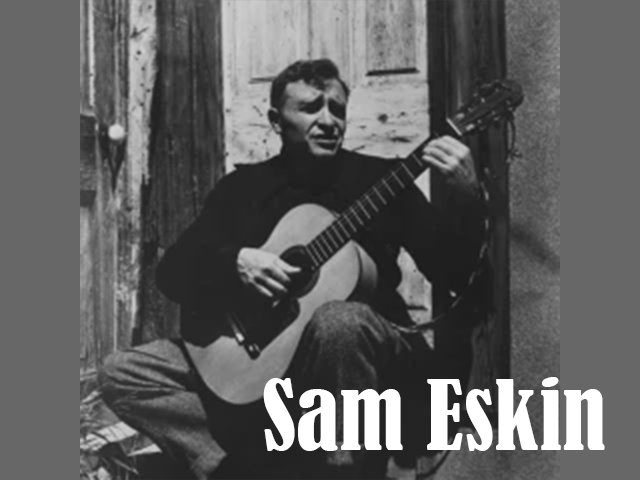
Ethnomusicologist Sam Eskin (1898-1974) traveled widely collecting and recording folk music. He was primarily interested in gathering and preserving all aspects of American folk culture. — From Smithsonian Folkways
Sam Eskin was born in Washington, D.C., July 5, 1898, the son of Russian Jewish immigrants. Sam was a city kid; Baltimore, Maryland in his early years, where his father worked as a locomotive engineer on the Baltimore and Ohio Railroad. At age seventeen Sam left Baltimore to travel west to Wyoming where he worked at cattle ranching and shepherding, railroading, and logging before winding up in a salmon fishery in Alaska. Sam later noted, it was the music he heard while working at these jobs which inspired his interest in singing and collecting folk music, not realizing at the time that the songs he heard were called folksongs. Sam was intrigued by these songs and began writing them down and incorporating the published works of other collectors; so the field of folksong collecting became a more serious pursuit for Sam.
In the mid-twenties, Sam Eskin left the fishery, joined the merchant marine, and spent the next few years sailing to many ports of call in Europe, Asia, and Central America. On these voyages he was exposed to a wide variety of music, from chants in Singapore to the songs of black workers in the towns of the Gulf Coast. Eventually, Sam gave up the sea finding a place in the radical bohemian community of San Francisco’s Telegraph Hill neighborhood. During this period Sam became immersed in the arts of music — learning banjo, guitar, and mandolin — teaching himself as a writer, photography, and sandal making.
In 1925 Sam met and married, Peral (Ann) Hefferlin who was a student at the University of California, Berkeley. For the next few years the couple traveled together in Europe, returning to the states in the late ’20s. In 1929 a pregnant Ann leaves Sam for France. By 1930 Sam has taken job with the United Parcel Service in New York — having briefly worked for the company in San Francisco. there he stayed for fifteen years working his way up from typist to executive.
From the mid-twenties to the mid-forties Sam’s lifestyle weaves through many of the counter-cultural centers of the world; from San Francisco to Aspen, Big Sur, Provincetown, Europe — primarily Paris and the south of France — and back to Woodstock, Greenwich Village and into a liaison with Cornelia Evans Goodhue, the mother of his second son.
By 1945, Sam is divorced from Ann and ready to throw off the confines of a daily job dedicating himself full-time to his passion: collecting folksongs. Three years later (1948) Sam settles on Woodstock, NY as a permanent base of operations from which to conduct his travels and collecting.
Sam’s collection spans the globe — most of it personally collected in the field. He has done much work in Europe and Israel, North Africa, Asia, Latin America (Mexico and the Caribbean) as well as extensive studies in the U.S. The collection includes not only folk songs, but all types of ethnic music, dance music, primitive drumming, stories, interviews, and any sounds of general cultural or aesthetic interest which Sam happens to have picked up in his travels – (one tape chronicles the roar of the Pacific on the west coast of Mexico). The result of his works rest in the songs which he transcribed to paper, but what’s more, in the impressive collection of original recorded material which he built up over forty-five years of collecting. He made his materials available to the Library of Congress as well as educational institutions interested in them. Sam also provided enough material for several commercial records.
In addition, Sam organized folk music programs at the University of California, at Columbia University, and others. He became familiar with the literature of his subject and maintained contact with other important scholars and collectors of his time. His demeanor, professionally and personally, was unconstrained and flexible, so that whenever his enthusiasm would be aroused he was ready to pursue any of the demands of his subject, either through books and records or, more likely, by packing his bags and taking a trip.
But for all that, Sam had not lost his original interest. He continued to sing the songs he liked: the newly discovered songs that caught his fancy, and the old songs which he first started singing when he tramped around the world in his youth. The original impulse toward song had been endowed with a myriad dimensions by his subsequent intellectual and professional activities. At the same time, these activities always were invigorated by the genuineness and spontaneity of the feeling from which they first evolved.
Sam’s life ended at his home in Woodstock, NY, where he died suddenly of heart failure on September 7, 1994.
Sam Eskin, who has been working in the field of folksong a long time, was born in Washington, D.C., July 5, 1898. His father was a railroad engineer, the Eskins lived near the tracks, and the turning wheels got in Sam’s blood: he’s been a restless wanderer since his teens. His formal schooling ended with the eighth grade in Baltimore, Maryland.
In early years Eskin was an avid reader of Jack London, whom he wished to emulate in adventures and in writing. At seventeen, with not much cash in his pockets, he set out for the West, and he soon learned the trick of riding the blinds. He did all kinds of work–on cattle ranches, on the railroads, eventually in the salmon fisheries of Alaska. Later, he went to sea, and his wanderings carried him to ports in the Orient, to Europe, and the Central America.
Sam Eskin wasn’t consciously searching for folksongs–at least not at first. But the songs he heard, before he knew they were folksongs, were the songs he liked to sing and remember. Though Sam is not a trained singer, he has a genuine feeling for folksongs and their background. As he himself says: “I never started out to sing folksongs. It just happened. And long before I knew about published collections I became an amateur collector just to find new songs to sing.” In time, of course, he studied the collections and enlarged his repertoire.
Over the past thirty-five years Sam has traveled with guitar and recording equipment in forty-eight states and in many foreign countries. He has many discs and tapes–and many memories, too. Not much beyond brief newspaper items has been published about him, for he has no high-powered press agenting. Though friendly and companionable, he seems paradoxically a lonely figure. A recent writer commented: “The details of his life are scanty, and Eskin does little to lift the veil.
A good deal of Sam’s early collecting and singing was done in New York, the Carolinas, Florida, Tennessee, Virginia, Texas, New Mexico, California, Colorado, Kansas, Indiana, and Delaware. Recently he has done much beyond our national boundaries. In the early 1950s he “collected quite a variety of interesting material” in Mexico, also a little in Haiti and Jamaica. In April and May, 1955, he was in Israel, collecting among the Jews and Arabs. From there he went to Spain for further searching.
— Quoted from Simon J. Bronner, himself quoting from a now-defunct website dedicated to Eskin.
Curated History
Born: July 5, 1898, Died: September 7, 1974.
Eskin appeared on The Kingston Trio's Stereo Concert Plus album, Side One, Track 3, "South Coast" along with Richard Dehr, Frank Miller and Lillian Ross.