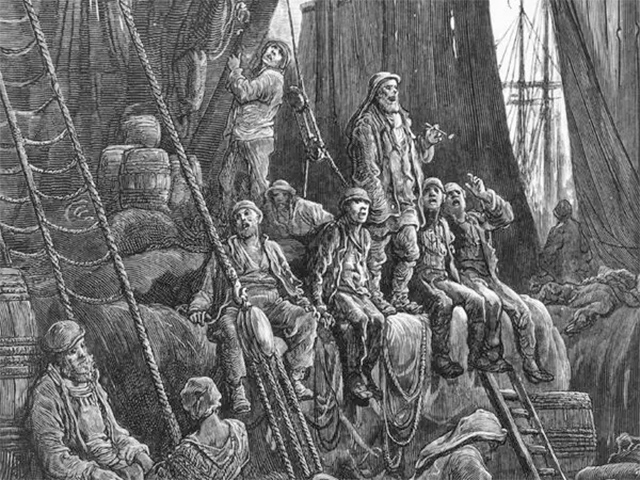
The long and storied history of sea shanties is filled with tall tales and heroic deeds and bitter complaints and silly stories and no small amount of the “not-for-polite-company” banter that inevitably appears when you have a bunch of guys hard at work in close quarters for long periods with basically no ladies present. We are told that in the late period of the age of sail, a sailor could be hired only if he could sing. Why was that?
Although they had their songs (e.g. Heart of Oak) and musical traditions, the shanty tradition could not be traced to the British Navy. First, the Royal Navy was much less particular about who became a sailor. Press gangs and those agents dropping“the King’s pence” into a flagon of dark ale that led to the design of the glass-bottomed tankard did not hold auditions or divide recruits into the baritones and the tenors. Secondly, the Royal Navy operated three-hundred foot ships with eight hundred people aboard. Commands for the sailors were given by complex whistle signals from the bo’sun’s pipe which (sometimes) could be heard above the howling wind. Commands for the Royal Marines were given by drumbeat patterns. If they needed more muscle for some function, they just woke up the “off-watch” and put them to work. There was no joyous bursting into song. This was no glee club. Strict silence was enforced. (One factor that makes Gilbert and Sullivan’s HMS Pinafore so funny is how it departs in so many ways from the reality of the Navy.)
So if it wasn’t the Navy what happened to engender the shanties?
It was technology.
The Old Navy (the navy—not the clothing store) was about moving a lot of heavy stuff at whatever speed it could. The battle did not start until they got there. Moving heavy stuff required big ships and square sails and big crews.
Then, in the early nineteenth century, a paradigm shift occurred. The fore-and-aft sail sailed into prominence. The ships became faster and sleeker. If you could get there faster, you did not have to carry as much in the way of provisions. The sails could be tended by much smaller crews, which further lightened the load. There was room in the ships for cargo and passengers and there was money to be made. There was bat guano in South America and slaving in Africa , and whaling all over. And the ships could be operated by just a few sailors.
It was a ship-owners’ Nirvana.
In addition to the new technology, it was possible to lure sailors to invest their time and labor into the “enterprise” by offering a share of the profits of the highly lucrative voyages, to be paid only at the completion of the voyage to those “still standing” at the dividing of the spoils. This system made it increasingly dangerous for sailors on the return voyage. Herman Melville reported this world in his novels.
There was just one problem.
When you are one of fifty people heaving on a sheet or a halyard, you are less likely to injure yourself with excess exertion than if you are one of a much smaller, understaffed contingent attempting a similar task in a howling gale. There is no “off-watch” to wake. The grueling physical work left many sailors with hernias, rendering them unable to continue their assigned duties. This situation meant that the already short-handed crew was short another man. This deficit could and did become an existential crisis for the shipowners.
Then, somebody figured out that hernias result much more frequently when a person is holding his breath, than when he is exhaling. (I learned this fact from Dr. Terry Todd, a professor of mine who was an Olympic weightlifter at the 1960 Rome Olympics and had a Ph.D. from Auburn University in “Progressive Resistance” )
The simple fact is that you cannot sing and hold your breath at the same time.
Singing also synchronizes the effort, and contributes to cohesive teamwork – and greatly reduces the likelihood of hernias.
You do not need a dulcet voice. You do not have to sing in tune. You do not necessarily need to know the words. You do not even have to speak or understand the language of the lyrics. (That’s what all that “Folly Rolly Di-do” stuff is about.). You just have to SING – more or less in time with your crew.
No, the shipowners were not music lovers. They were, however, pragmatists – and their crews benefited from the change, not only physically, but by entertaining themselves through long boring voyages interspersed by hours of grueling toil and moments of intense panic. They created the rich shanty tradition which we now honor, enjoy, and attempt to replicate.
Joe Cook was a founding member of the Columbus, Ohio, USA’s Hardtackers.