
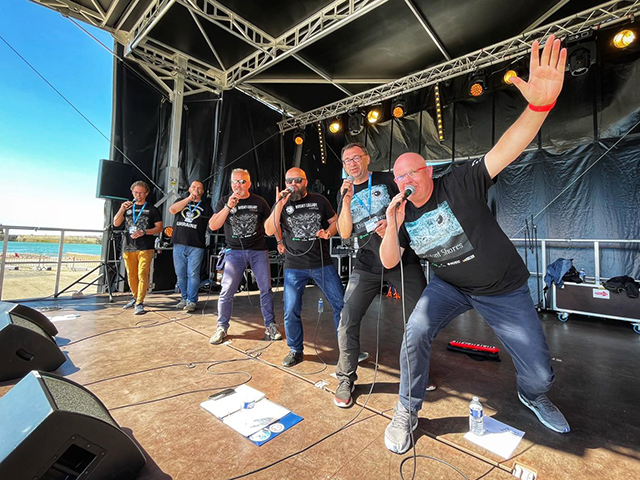
Posted by Perły i Łotry on Facebook 15 Mar 2026.
It’s everything that should be. MP’s signatures, justification, seal of the Parliament Marshal. We are starting to work on the “Year of the Polish Shanty”. Is it going to work? I don’t know. A lot depends on us – so called “Environment”. Proposed resolution content below.
Outreach is being made to the Parliament of the Republic of Poland
2027 will be the 50 year anniversary of the first festival “National Sailing Song Exchange” in Górki Zachodni – the first professionally organized shanty festival in Poland.
The Polish shanty movement is a global event. Niche music inspired by the traditional songs of the seas echo in a country whose maritime traditions developed specifically in the twentieth century between the wars.
Shanty festivals organized in Polish cities set the standards for the presentation of this type of music and are a model and cause for envy for the organizers of international events of this type. On the Polish shanty scene there are aces of English, Breton and American maritime folk music. At the same time, Polish albums with maritime music are selling well and Polish performances of marine songs are generating millions of plays in digital media.
The Parliament of the Republic of Poland, convinced of the value of the Polish shanty movement for our cultural life, expresses its respect for all former and present artists, animators and popularizers of maritime music in Poland and establishes the year 2027 as the Year of the Polish Shanty.
What is this music?
Naval work songs, called shanties (Polish: “shantami”), were used to coordinate human effort on the decks of tall ships. Due to the multinational nature of the crews at that time, the naval songs carried with them a folk tune from many parts of the world – from England, France, Spain and the Netherlands to European colonies in both the Americas, Africa and Australia. The last working tall ship shantyman – Stan Hugill, in later years researcher and promoter of maritime culture (and also a special guest of the Krakow Shanties festival in 1986) was one of many who collected and described the artistic achievements of generations of sailors in the work “Songs of the Sea” published in 1977. In the same year in the Western Hills – Gdansk district, the first Polish shanty festival – songs of the seas – took place. The winner of the first prize of the “National Sailing Song Exchange” was Mirosław Peszkowski – captain of the great sailing ship, later commander of the “Gift of Youth”, artistically active to this day.
To Whom Do We Owe This?
Maritime music found receptive ground in Poland thanks to the work of a dozen people – journalists, sailors and shantymen. Back in the ’70s of the 20th century, the band “Refpatent” was created in Jód ów, whose founders – Jerzy Rogacki and Zbigniew Zakrzewski – translated traditional sailing songs into Polish and then performed them on the stages of student music reviews. Regardless of them shants, Janusz Sikorski, a journalist and one of the co-founders of the group Old Bells (Polish: “Stare Dzwony”) promoted on the air of the Scout Broadcasting Polish Radio. In the radio program “Clipper of the Seven Seas”, dedicated to sailing songs, he collaborated with Mark Szurawski, author of the work “Shanty and Shantymens – Songs and People from Big Sailing Boats”. The ’80s brought great popularity to the “Shanties” festival in Krakow, still called the “Capital of Polish Shanties”. At the following festivals in many Polish cities – “Rafa” in Radom, “Kopy Nać” in Bialystok, “Wiatrak” in wwinoujscie, “Bezan” in Tarnów, “Kubryk” in ”ód -, “Jeziorak Shanties Meeting” in Ilawa or formatted especially for children “Spring Szantowisko” in Bytom – a variety of Polish shanty performances were presented. Polish parties were often hosted by foreign artists in this genre, constantly being impressed by the organization and artistic level of Polish parties.
Polish Diversity
The phenomenon of the popularity of Polish maritime music lies in adapting melody, lyrics and method of performance to the taste of the native audience. Polish shanty movement has refined many styles and artistic subjects. In addition to classic performances of maritime labor songs promoted by “Four Reefs” (Polish: “Cztery Refy”), “Roaring Twenties” (Polish: “Ryczące Dwudziestki”) or “Shanty Mechanics” (Polish: “Mechanicy Szanty”), a countless number of sailing ballads and maritime poetry have been created. Jerzy Por egbski, Andrzej Korycki, Beata Bartelik, Jerzy Ozaist, Mirosław Kowalewski, Paweł J Jdrzejko or Krzysztof Jurkiewicz are just a few names from the wide group of authors of sailing songs, lyrics and translations. Thematic publications related to maritime music are published regularly. The albums of the leading Polish shanty artists achieve thousands of downloads despite the competition from digital platforms. A phenomenon in itself is the only Polish “Szantowy Zawisza Czarny Choir”, attributing the name and origin to the popular scout sailboat. Szanty became the subject of several master’s theses and a dozen scientific papers. Traditional music of the seas and oceans is creatively developed in Polish, Irish, Breton or Scandinavian patterns receive unique arrangements. Polish bands are received with honors at the world’s largest festivals in America’s Mystic Seaport, France’s Paimpol, England’s Harwich or Norway’s Langesund.
50 years of Polish Maritime Music
If, according to the connoisseurs of the subject, accept the “National Exchange of the Sailor Song” as the beginning of the excellent path of the Polish shanty movement, then 2027 will be a jubilee year for this music. Many creators of the most popular sailing hits are no longer among the living. Andrzej Mendygrał, captain of a great sailing ship and author of the legendary “Spanish Girls”, passed away in 2019. In the same year, Jerzy Rogacki, known among other things for his outstanding translation of the traditional song “Leaving of Liverpool” known in Polish version to every sailor, died. 2 years later we said goodbye to Jerzeg Por Dziebski, creator of the great sailing hit “Where’s the Keja”. Great shant instrumentalists have also left us – violinist Józef Kaniecki, guitarist Dariusz zelalewa and singers – Janusz Olszówka, Andrzej Grzela, Wojciech Dudzi ukski or Dominika udziukowska. Every year new performers appear on the Polish shanty scene. Festivals in Krakow, Wrocław, Tychy or Gdansk gather thousands of devoted fans. New albums inspired by the songs of the seas are being created. On the 50th anniversary of the first Polish shanty festival, it is worth to pay honor to all the organizers of the shanty movement in Poland. Let the current resolution of the Parliament of the Republic of Poland be an expression of appreciation to all who have contributed to popularizing the music of the seas and oceans in our country. In all her, how rich and diverse, varieties.